This summer is predicted to be one of the hottest ones on record. To cope with the heat, recreation on and near the water has become ever more popular. New York City is surrounded by water, and the iconic Hudson River, New York’s landmark river, is among the most popular destinations for recreation. Given its long and complicated history in shaping both New York and New Jersey, we often wonder: can you actually swim in the Hudson? While laws such as the Clean Water Act and Toxic Substances Control Act have helped to make the river the cleanest it has been in 100 years, the perception of the river as a waste site that is dangerous to touch continues to persist.
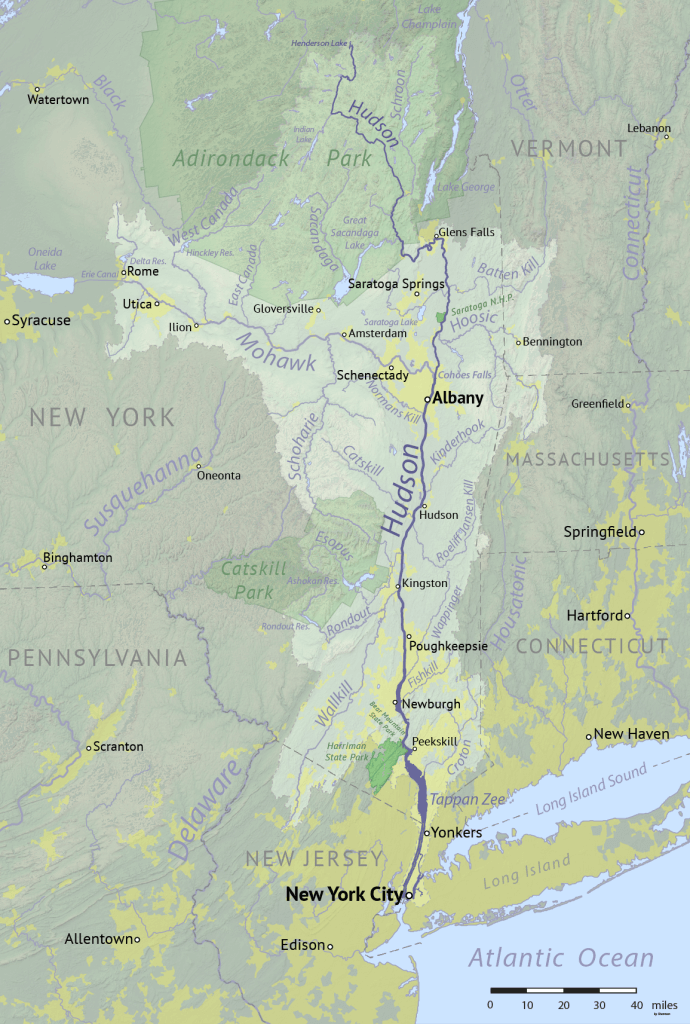
The Hudson River is a 315-mile-long tidal river starting from the Adirondack Mountains of Upstate New York, flowing almost in a straight line down through Albany, and emptying into New York City. While primarily fresh, the water of the Hudson River is brackish up to Beacon and is tidal up to the locks of Troy. Having gone through several names (Mahicannittuk, Rio San Antonio, the North River to name a few), and much like the city it borders, the river is no stranger to change.
The completion of the Erie Canal in 1825 created a connection between the Hudson with the Great Lakes, opening the vast expanse of the Midwest to trade and catapulting New York ahead of every other American city. The river was deepened and dredged several times to allow for the passage of large ships, an act that benefited the river and region economically, but left the river’s shallow water ecosystems devastated. The river continued its ecological decline into the 1970s, due to the unregulated dumping of industrial waste, particularly the 1.3 million pounds of Polychlorinated biphenyls (PCBs) that were dumped into the Hudson at GE manufacturing plants based in Fort Edward and Hudson Falls. After a 30-year period, the dumping finally ended in 1977 after the EPA banned the production of PCBs. Today, 200 miles of the Hudson River are classified to be a Superfund site, making it one of the largest such sites in the county.
Fast forward to today, where due to climate change, the number of days over 90oF are increasing, and taking a swim in the Hudson would help to cool us off, but is it safe? The short answer is “Yes!” The long answer is that it depends on when and where. Issues like sewage outflow and algal blooms keep many areas along the Hudson from being swimmable, particularly after rainfall. However, there are four public beaches currently operating along the Hudson River: Croton Point Beach, Beacon River Pool, Kingston Point Beach, and Ulster Landing, sites all found in the mid and lower Hudson Valley and a short drive from New York City. Beyond that, the New York State Department of Environmental Conservation has found more than one hundred informal swimming sites along the river.
The general guidelines for swimming in the Hudson are to:
1) swim at an operating beach;
2) not to swallow the water;
3) make sure to keep your head and face above water;
4) rinse off after swimming; and
5) not to swim in areas with heavy vessel traffic.
While there are no official recommended places to swim in the Hudson River within the boundaries of New York City, there are plenty of opportunities to swim in the river within city limits. Events such as the New York City Triathlon, Hudson Crossing Triathlon, 8 Bridges Hudson River Swim, The Liberty to Freedom Swim, the 20 Bridges Swim, and the 40 Bridges Swim are all organized swimming events taking place in and around New York City. There are also several human powered boat launches for kayaking, canoeing, and stand-up paddle boarding on the Hudson. City of Water Day, taking place this year on July 15, is a great opportunity to explore the Hudson River, with dozens of activities taking place along it (or find something closer to home in your neighborhood!).
Disclaimer: Waterfront Alliance does not endorse or encourage swimming in the Hudson River, unless at an operating beach or through participating in an organized event. We want your time in the water to be safe and enjoyable.