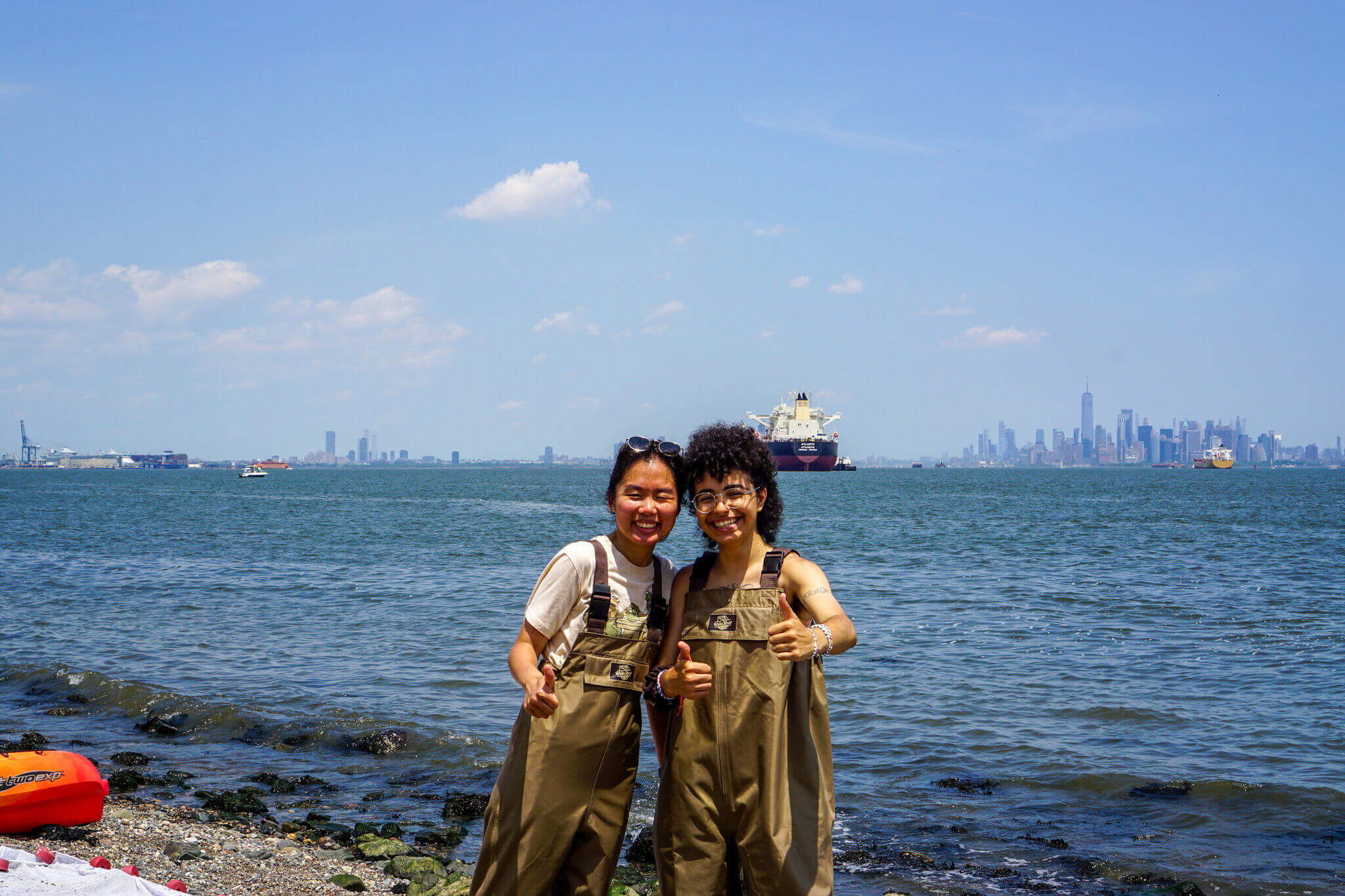
The proverbial waterbug bit Jesseanne Ribaudo at a precocious young age. Growing up near Coney Island, Ribaudo always loved the water, making frequent beach visits an essential part of her summers and immersing herself in nature whenever possible. But it was her experience at the Urban Assembly New York Harbor School on Governors Island that really set her on a coastal career trajectory. As Senior Education Program Manager, the latest addition to the Waterfront Alliance team brings a lifelong fascination with marine life and restoration work to her exciting new role.
For our Women on the Waterfront series, we spoke with Ribaudo about her rather unique formative years, and how they led her to Waterfront Alliance.
Turning a new LEAF
Ribaudo didn’t always have designs on the Harbor School – a career and technical education (CTE) institution with a maritime-focused curriculum – but she felt ambivalent toward the array of South Brooklyn options suggested by middle school teachers. When a trusted older friend attending Harbor School recognized her proclivities and gave her a nudge, her interest was piqued. Then her aquatic-enthusiast grandfather – who built tiny models of boats in bottles – weighed in with some salty sailor’s enthusiasm, convincing her to step out of her comfort zone.

Jesseanne in action. Credit: New York Harbor School
“At Harbor School, I threw myself into the community,” Ribaudo recalls. “I would give tours to younger kids – prospective students exploring the campus. And then, after sophomore year, I took an internship in Montana that really took things to another level.”
This Montana sojourn was offered by the Nature Conservancy for students at environmental high schools.
“It was called the LEAF Program – Leaders in Environmental Action for the Future,” Ribaudo notes. “And you don’t know where they’ll send you. You just apply and then cross your fingers.”
Ribaudo ended up in Montana’s Centennial Valley, doing restoration and monitoring work, including charting the spawning habits of native fish and building mock beaver dams in an effort to raise floodplains. And on weekends, they’d camp at iconic national parks like Yellowstone, Glacier, and Grand Tetons.
“After Montana, I was definitely thinking ‘this is it… this is what I want to pursue,” Ribaudo recalls of the rare and indelible experience.
Out of the Lab
Back at Harbor School with an elevated verve, Ribaudo began interning at the on-campus aquaculture lab to complement her chosen CTE track.
“I worked there all year, inoculating algae to keep its population healthy for our oyster brood stock,” she explains. “This was my first opportunity through the school to do real, in-depth lab work.”
That summer, she hung up her lab coat and headed to camp, getting a professional taste of environmental education as a coastal classroom counselor near Coney Island Creek via the City Parks Foundation.
“We taught kids how to fish and, through that, about fish biology,” she notes. “And while I enjoyed the science side of things, I really gravitated toward spreading that information. I loved teaching the next generation of environmental stewards, sparking the joy in younger students that had already been sparked in me. That was when pieces really started to fall into place.”
Island Time
Prior to her arrival at Waterfront Alliance, Ribaudo spent three years with the Randall’s Island Park Alliance as seasonal educator and then restoration coordinator.
“I got the best of both worlds,” she says. “I was out in the field, getting dirty, doing restoration planting and biological monitoring, but I also got to bring students into that work. They would come out for field trips, and we’d give them tours of the salt marsh. They could learn about and handle the animals living there, live and up close.”
As she transitioned to restoration coordinator, the educational element receded somewhat.
“The field trips remained the purview of the seasonal educators, which I no longer was,” she laments. “And while I appreciated the heightened focus on restoration, I started to miss the educational component, even though I still engaged with it here and there. I would ask the seasonals if I could be more involved with classes and field stuff, even if it wasn’t necessarily what I was supposed to be doing.”
Fully Allied
It seems serendipitous that the Senior Education Program Manager position with Waterfront Alliance was opening up just as Ribaudo was feeling a heightened inclination toward teaching. It also marks the completion of a circle, as Ribaudo was actually involved in a Waterfront Alliance Club back in her Harbor School days.

Jesseanne, pictured left, working on an education assignment. Credit: New York Harbor School
“I was only around fourteen at the time, but I do recall a long-standing relationship between Waterfront Alliance and the Harbor School,” she says. “And I remember the stickers… we definitely got stickers and discussed what we’d like to see the waterfront look like in 10, 20, 30 years.”
Now, Ribaudo gets to deploy her finely honed teaching techniques via the Waterfront Alliance Estuary Explorers program and beyond, and she’s ready to get her hands dirty.
“Estuary Explorers usually ends with a field lab where they do a beach clean-up, or go seining and learn about fish,” she explains. “But I’m hoping to bring more hands-on experience into the classroom as well. I don’t care if I have to lug a bucket of salt and brackish water across town for testing. When the weather doesn’t allow us to go outside, I want to find ways to bring the outside in.”
The essential environmental experience Ribaudo received at Harbor School is something she’d like to emulate through Waterfront Alliance.
“Most of my aquaculture classes were not in front of a screen,” she notes. “I was outside on the docks. I was in the lab getting covered in mud and reeking of fish. And that real-world element is necessary in sparking any type of passion or interest in young people, who get talked at all day, all the time.”
Ribaudo would also like to better incorporate her passion for wetlands into the scope of the organization.
“We often conflate ‘waterfront’ with man-made infrastructure, occasionally giving short shrift to ecosystems and wildlife,” she observes. “And Waterfront Alliance clearly does advocate for that stuff, but I’m just so enthusiastic about wetlands, salt marshes, etc., and would love to include more of that in our lessons and experiences.”
If anybody can get young upstarts amped about marine life and coastal resiliency, it’s someone who’s been dedicated to this work since they themselves were a teen.
“I don’t think I’ve ever really deviated from this path,” Ribaudo reflects. “Even my plant conservation and restoration work has always revolved around wetlands, so I didn’t stray far. This has really been it for me since Harbor School.”