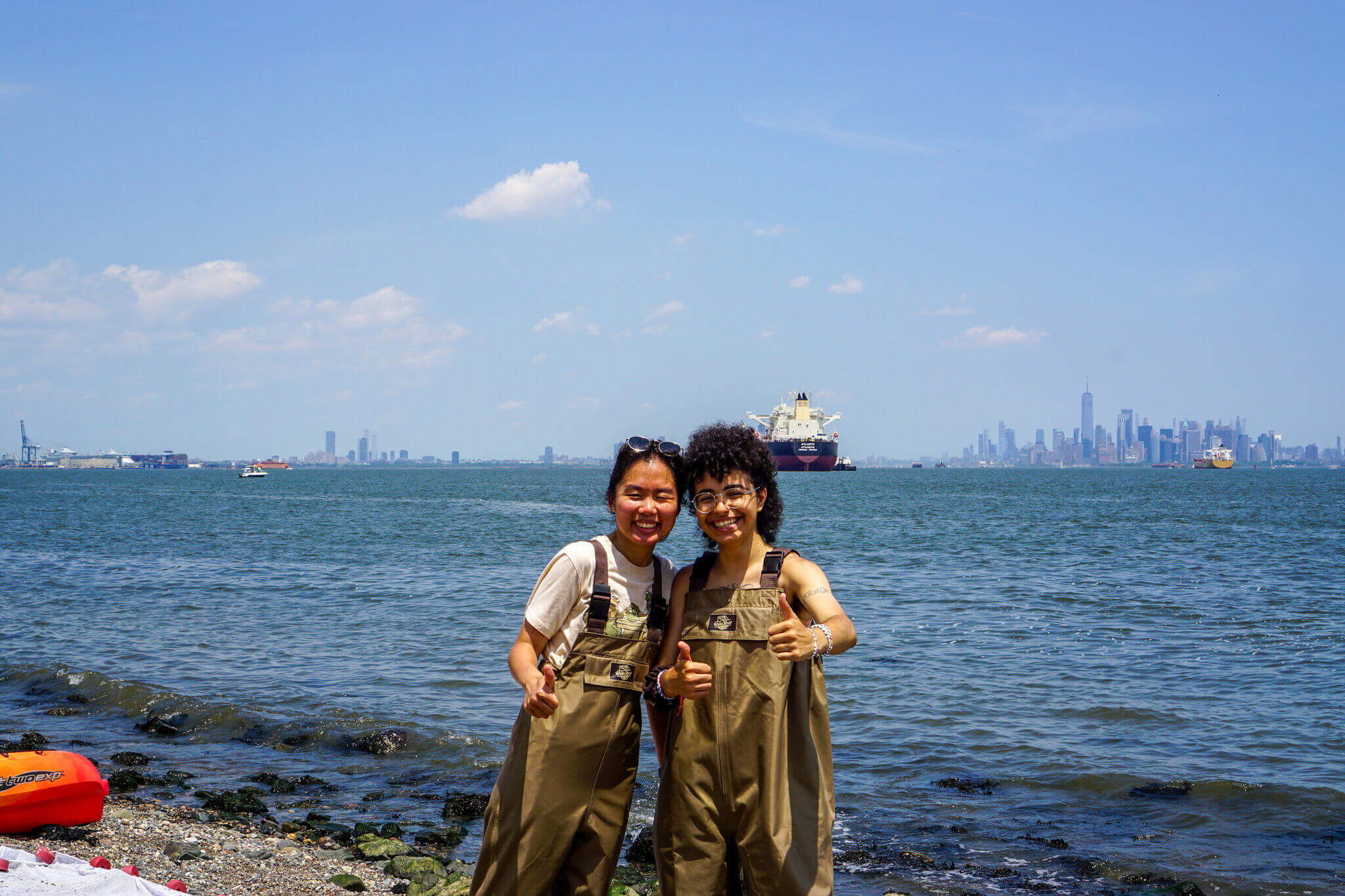
Whether as an educator, urban planner, policy advisor, or program director, Lauren Wang has had her feet planted firmly at the water’s edge for the majority of her career. In her current role as Director of Climate Programs with The Trust for Governors Island, Lauren has spent nearly four years helping various pilot initiatives and youth education efforts set sail at one of the city’s most exciting climate solutions hubs.
For our annual Women on the Waterfront series, we spoke with Lauren about the myriad ways students and professionals alike can engage with and affect the waterfront.
I’m On a Boat
A life-long waterfront enthusiast, Lauren recalls her initial encounters with Waterfront Alliance occurring at sea.
“Early in my career, I had the opportunity to attend my first Waterfront Alliance conference,” she says. “And I was delighted to find myself on a boat! It was refreshing to take a step back from my day-to-day and hear perspectives about waterfront issues more broadly.”
At the time, Lauren was supporting with Hurricane Sandy recovery efforts and was thrilled to find herself among so many like-minded individuals. It inspired her to remain within the Waterfront Alliance orbit.
“More recently, [Waterfront Alliance Director of Policy and Government Affairs] Tyler Taba invited me to join their team for the New York Dragon Boat Festival on Meadow Lake in Flushing Meadows Corona Park,” Wang adds. “Rowing with the Alliance gave me a unique vantage point to learn more about issues facing waterfront communities in Queens, while supporting the Alliance in its work.”
As she took on increasing responsibilities in her career, Wang found herself intersecting with many of Waterfront Alliance’s initiatives.
“My career in New York City started in flood resiliency and the waterfront, and at Governors Island my role has expanded to a wider range of climate solutions, including sustainability, circular economy, electrification, blue highways, and other issues that I’ve seen at recent Waterfront Conferences,” she shares. “I’ve been impressed and delighted to watch the Alliance evolve as the suite of climate challenges, solutions, and leaders expands.”
Early Inspiration
It’s probably worth mentioning that, in college, Wang studied to become a literal neuroscientist.
“I was a quiet kid who loved nature,” she explains. “At the outset of college, I explored a lot and tried to soak up all that I could. Ultimately, I graduated with a bachelor’s in neuroscience and a minor in urban studies, to which people reacted, ‘What does that even mean, Lauren?!’”
They say hindsight is 20/20. Her scientific background very much informed the analytical framework and curiosity with which she aimed to understand how we perceive and shape the world around us. After a short stint with a midtown law firm during the Great Recession of 2008, Lauren gained confidence that she could make a go of it as an urban planner, receiving a Masters of City and Regional Planning degree in 2012.
“I finished graduate school in 2012, and later in the same year Hurricane Sandy hit,” she recalls. “It felt like a call to action. I’m a science-loving urban planner, witnessing a catastrophic event in the city I love, and that’s likely to return due to climate change. I found my way to the Department of Housing Preservation and Development (HPD), directly supporting New Yorkers who had lost their homes in the storm or who were living in homes and neighborhoods that suffered substantial damage. The experience forged my moral compass and inspired my commitment to collaborating with people on effective, equitable, and practical climate solutions.”
Ten-Year Plan
Her stint with HPD led Wang to the NYC Mayor’s Office of Climate and Environmental Justice during the de Blasio administration where, as Senior Policy Advisor, she worked with the Department of City Planning on New York City’s 10-Year Comprehensive Waterfront Plan.
“The first Waterfront Plan came out in the 1990s and established that New York City has this incredible waterfront that needed to be cleaned up and restored,” Lauren explains. “In the 2000s, the plan celebrated the access that had been opened up during the Bloomberg administration. The 2010s plan analyzed the risks of climate change on the New York City waterfront and began assembling key datasets and information on ways to adapt.”
Hurricane Sandy and concurrent studies on heat vulnerability that later became the Heat Vulnerability Index added a resounding sense of urgency to the crafting of climate policy.
“Many people learned a lot in the past decade about urban coastal adaptation,” Wang notes. “We’d also begun to recognize and address multi-hazard threats, such as extreme heat and stormwater resiliency. It’s absolutely a waterfront resiliency issue that, every year, approximately 500 New Yorkers die due to extreme heat and heat-related illness. The 2020s Waterfront Plan brings climate to the forefront and establishes a framework for actions happening at both the community and city levels to address climate risks. Racial equity was an urgent priority in crafting the 10-year vision.”
Island Time
Now, at Governors Island Trust, Wang continues to shape our waterfronts.
“I lead the Trust for Governors Island’s Climate Piloting Program, which invites startups and non-profits to bring a temporary pilot to Governors Island to prototype innovative climate solutions,” she explains. “In three years, we’ve worked with 24 companies that have found success with climate solutions ranging from living shorelines such as onshore wetlands in a box or seaweed farms, to circular economy solutions and new, low-carbon building materials.”
“Governors Island is a fun place for people of all ages,” she enthuses. “You hop on a ferry, the sky opens up, and you’re transported into a different state of mind. The Trust is working to expand educational opportunities for young people on the Island, including its annual Earth Day Celebration and hosting NYC Public School’s annual Youth Climate Summit in May for the third year running. We’re very excited to provide kids with hands-on ways to engage climate solutions and introduce them to climate innovation and the work of incredible nonprofits like the Billion Oyster Project and GrowNYC.”
Stay Studying
In addition to all the above, Wang teaches as an adjunct lecturer on Environmental Justice in The City College of New York’s Sustainability in the Urban Environment program and Colin Powell School.
“At CUNY, through the NYC Climate Justice Hub, New York City Environmental Justice Alliance, and its members, my students and I are very fortunate to have direct access to some of the environmental justice organizations that have been fighting on behalf of their respective communities for decades,” Lauren notes. “I truly believe education is a two-way exchange, and teaching at CUNY continues to be a great learning experience.”
Lauren observes that, as of late, students are entering higher education with a heightened awareness of climate and environmental issues both locally and globally.
“They’re tremendously motivated to take action,” she says. “What I try to do via my class is to ground in physical reality what they may have absorbed via social media or through their own activism. Over the past few years, I’ve been fortunate to work with the New York City Climate Justice Hub and its partners on practical, student-led projects. For example, we’re currently focused on addressing air quality issues and supporting community resiliency in Hunts Point, in the Bronx, in collaboration with The Point CDC.”
Forward Momentum
Despite her admirably busy present, Lauren keeps an optimistic eye turned toward the future.
“I’m always thinking about what we can build together to make tomorrow better, and even great,” she says. “I’m excited about all of the brilliant leaders I get to collaborate with, and to continue my relationship with Waterfront Alliance.”
She’s also bullish on the Zohran Mamdani mayoral administration.
“Mayor Mamdani seems to understand how to meet people where they are,” Wang observes. “That skill and ability to focus are going to be so important with the suite of urban adaptation solutions that are being developed for the waterfront.”
Whatever may be next for waterfront resiliency in New York and beyond, Lauren is sure to be involved, advocating for innovation and equity in progressive climate solutions.